
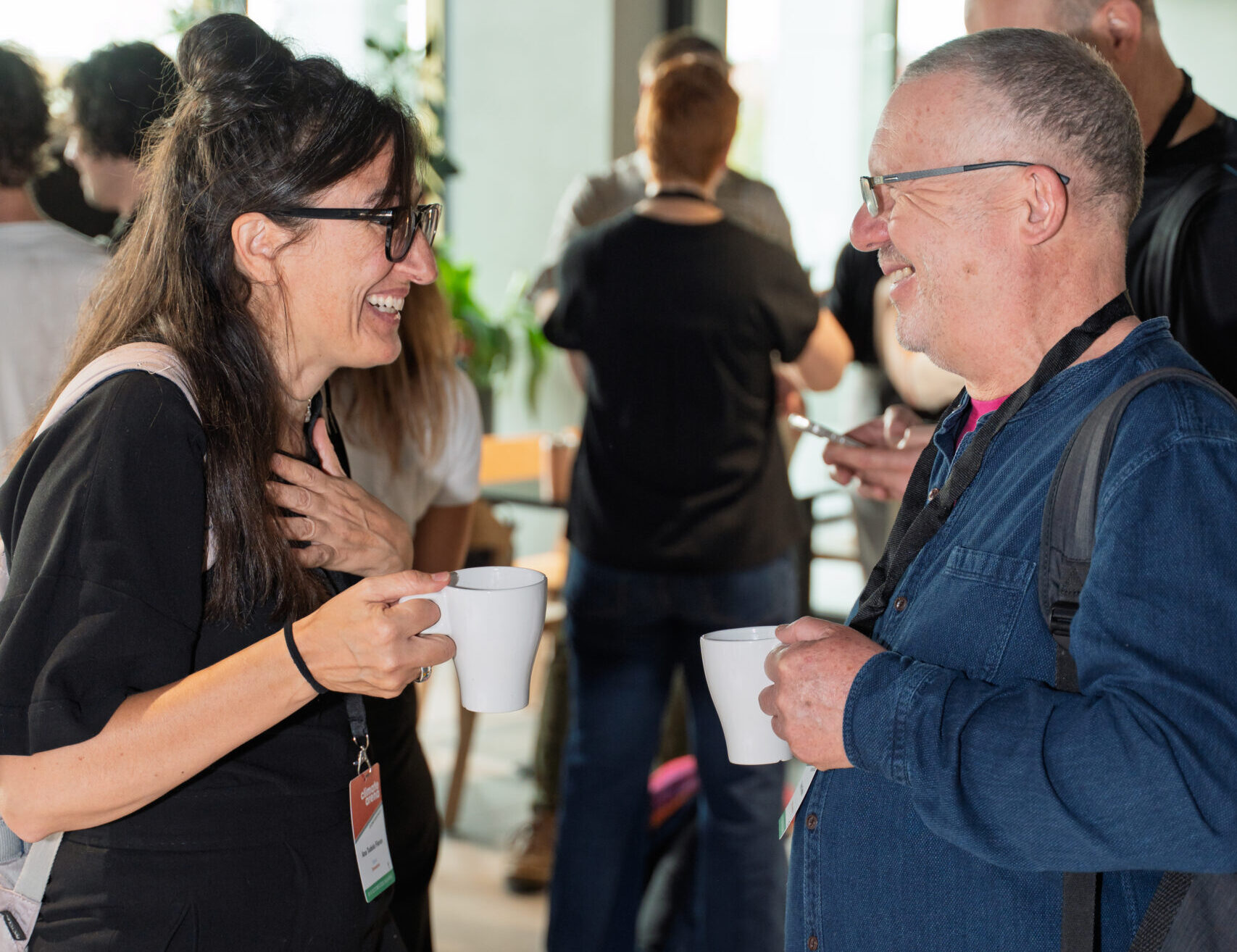
Many of Europe’s most expansive, illuminating investigations did not begin in a newsroom. They began in an auditorium, with an idea sparked by a quote on a powerpoint slide; or in a coffee shop, brainstormed with two new colleagues from across the continent; or over a beer, at the end of a long conference day, when two journalists inspired by the same talk realised they had complementary skill sets.
Often, the results of these meetings between colleagues, old and new, are presented in the same, aforementioned auditorium a year later.
Dataharvest, Arena’s flagship conference, has become one of Europe’s most consequential gatherings in investigative and data journalism over the last fifteen years. What started in the mid-2000s as a small group of colleagues applying freedom of information legislation as a reporting tool, and pioneering data journalism, has grown into a sold-out annual event.
In 2025, Dataharvest attracted more than 500 international attendees, from 47 countries, and 58 nationalities.
The history of Dataharvest
The conference’s roots come from a major cross-border collaborative investigative project. In the mid 2000s, a group of journalists from across Europe set up the Farmsubsidy.org network to fight for transparency around the EU’s generous subsidies to the agricultural sector. They applied data skills and access to document methods, and in 2009 began to meet annually in Brussels, to harvest data and publish their findings in their respective countries.
From 2011 until 2018, the ‘Dataharvest’ event was hosted by what would become Journalismfund.eu, opening its doors as a meeting place for three distinct communities pioneering the new field of ‘data journalism’: journalists, coders, and FOI specialists.
By 2018, the event had grown into a significant annual conference, leading to the formation of Arena, a parent organisation to facilitate this and other collaborative journalism activities across Europe.
Under Arena, Dataharvest kept on growing, gathering a reputation as a conference that did not end at simply ideas- and skill-sharing, but specialised in building new networks and developing collaborative, multi-publication investigations.
“Like an annual family meeting”
Statistician and data journalist Purity Mukami, a regular Dataharvest participant, felt its value as a meeting place for collaboration in 2024 when she was investigating the Kenyan government’s use of AI in healthcare.
“My initial instinct was to check for bias. That’s what any statistician would do,” she says, but she wanted to “investigate it through a journalistic lens.” She came to Dataharvest in search of partners who might help her dig into the data.
Purity approached Lighthouse Reports’ Gabriel Geiger following his talk on ethical AI and investigating algorithms, and a partnership was sparked: “What began as a technical audit soon spiraled into an investigation into the “black box” of Kenyan social policy,” Purity says.
As a result, the major data investigation “Hiding Behind AI”, a collaboration between Africa Uncensored, Lighthouse Reports and the Guardian, was published in 2026.
Eva Belmonte, another regular participant of Dataharvest and co-Director of Civio, cites the conference as crucial to connecting them with international journalists and facilitating some of their major cross-border work. The international award-winning, multi-publication investigation into the gap in global access to health, Medicamentalia, was born at the conference:
“For a medium non-profit newsroom as we are, having such a list of contacts of people in other countries with similar interests is key.
Dataharvest is like an annual family meeting where you can learn the latest techniques, share in a very generous way things that worked and that didn’t, get new fresh ideas for investigations and know other colleagues across Europe working on the same topics and/or using the same techniques to work together and go way further than you would go on your own”.
Developing (diverse) networks
The Arena team not only works to ensure that journalists have opportunities to brainstorm story ideas, and coders can run sessions to trade methods at Dataharvest, but also to build a collegiate, multi-cultural atmosphere co-created by journalists from all across Europe and further afield.
Stefan Candea, co-founder of European Investigative Collaborations (EIC), has been attending Dataharvest since its earliest days and meets with the EIC there every year. He says the conference “is a good place to discuss concrete ideas for stories because it is more hands-on than other conferences, and appears to have younger participants in the audience, and on the panels.”
The practical skills- and ideas-sharing is a crucial core of the conference, but so is our responsibility to earn our reputation as ‘the place to meet each other and work together’. Candea shared that he’d like to see more match-making on investigations, and sessions that “are critically researching our own powers in the Western world.”
Our team has recognised the need to be more proactive in inviting underrepresented journalists to deliver the programme and activities, for example, by actively choosing speakers rather than relying only on those with the time and confidence to perfect pitches. We have also fundraised to build the All of Europe programme, allowing us to bring traditionally less represented demographics — journalists from Central, Southeastern and Eastern Europe, and journalists in exile — to the conference.
We’re currently considering which demographic data to track — and how to ensure a focus on community building rather than simple numbers and targets — but one area of success has been the gender diversity of our community. Bucking a trend in both journalism and tech fields, in 2025, 52% of attendees were women; as are the majority of the leadership team of both Arena and Dataharvest.
Feedback gathered across demographics suggests the conference is a friendly space in which journalists, often doing difficult, indefinite, lonely — and sometimes traumatic — work can build networks of international support. Still there is a lot of work ahead of us; we are currently developing our diversity strategy, driven by the knowledge that successful community building is the ‘networking’that makes dynamic teams and publications that challenge power dynamics and global inequities possible.
The core is collaboration — and publication
The core ethos of Dataharvest foregrounds the purpose of all Arena’s work: sparking, facilitating and driving publication of impactful, collaborative and cross-border journalism across Europe.
Arena also runs training throughout the year, including the European Collaborative Journalism Programme (ECJP) in partnership with the Alfred Toepfer Foundation. This five-day immersive training offers junior and mid-career journalists a programme to build networks, developing collaborative story ideas, and stress-test them with expert feedback.
After completing the ECJP, journalist Gianluca Liva, a contributor to major cross-border investigations supported by Arena such as the Forever Pollution project, reflected that “Both [Dataharvest and the ECJP] were truly formative moments for me, giving me the tools to pursue a kind of journalism that goes beyond borders and disciplines alike.”
It is, of course, the journalists’ own hard work that brings these crucial investigations to fruition. But in particular, where seasoned journalists like Purity, Eva, Stefan and Gianluca meet their established networks each year at Dataharvest, young journalists from different backgrounds, facing different barriers, might need help in landing a first major piece, or meeting with potential collaborators.
All our activities are geared towards supporting people at all levels of the industry to publish. Younger journalists are supported by our fellowship trainings, which provide direct mentoring, plus advice on how to choose editors to pitch to, and how to build source networks. In addition, half the funding is released only post-publication to encourage follow-through.
After her fellowship with Climate Arena, our other annual conference, Steffie Banatvala credited the experience with no less than the launch of her career:
“Climate Arena played a pivotal role in helping me break into investigative journalism this year […] Through their network, I connected with a team that went on to secure my first grant… Now, I have three investigations underway.”
Daniel Shailer launched his investigation into Norwegian fishing companies’ collaboration with Russia post-invasion, as a fellow of Climate Arena in 2024. He credits our mentor’s work towards supporting his publication, and throughout his networking and source-building, even post-fellowship:
“I’m grateful to the fellowship for funding travel to meet key sources and time spent crunching figures. I’m particularly grateful to Jonathan Stoneman for talking through different angles I might take (political, national security, environmental) and for his advice during the fellowship to think through each stage of any supply chain in the search for sources.”
Arena is developing further trainings, and seeking to expand our access programmes, based on community and participant feedback.
In a fragmented European media landscape, where declining resources threaten our work on numerous fronts, Arena continues to play quiet but vital roles: mentor, facilitator, and matchmaker.
***
We’re tracking the major investigations and networks that have been published or launched as a direct result of Arena’s work. If you’ve published an investigation, launched a network or engaged in any other journalistic work as a result of attending Arena’s events or trainings, let us know at media@journalismarena.eu